
Flags in all their forms – actual flags, but also their 2D offspring printed on a carton of milk or the plastic rapper around a cucumber – the monarch’s head on postage stamps, the NL, N, E etc. on number plates, the map used during the weather forecast, the distinction between internal and external affairs, between “us” and “them”, phrases likes “our” prime-minister, “our” economy… these are just a few ways in which we on a daily basis are reminded of our national identity. Or maybe “reminded” is not the right word, as all these little, seemingly trivial things are so subtle that we hardly even notice them anymore. And yet they are very powerful: our national identity becomes something subconscious, something that is just there, a banal background to our daily routines, something that is naturalized to such an extent that we don’t recognize it anymore as what it actually is: a construct. The British historian Michael Billig has termed this phenomenon “banal nationalism”.
A primary example of banal nationalism are street names. Through the naming of public spaces after notable historical figures, a dominant vision of the national past is literally made part of the physical environment in which people go about there daily business. Over the last years, however, street names have lost much of their banality as naming practices have come under attack. Where are the women? Do we consider persons who were involved in colonialism or slave trade or some other evil still worthy of the honour of having a street named after them? Is it not time to rename a street here and there?
In this article, I will steer clear of this debate. I will only say this: renaming is neither cumbersome (it has been done many times before) nor does it constitute an erasure or denial of the past. So why the f*** not?
With that being said, this article addresses a different subject: the practice to name streets after famous historical figures from outside the own nation. I will also not dwell too much on the possible implications of this phenomenon. (Does it turn the daily passers-by into citizens of the world? Does it dilute the effects of banal nationalism? Why are Dutch cities particularly generous in naming streets after international figures, while this is quite uncommon in Scandinavian cities?) Instead, I want to carve out one specific naming practice in one specific city: the dedication of streets and other public spaces to “Great Scandinavians” and Scandinavian geography in Amsterdam, my place of birth. I will call this practice “Banal Scandinavism”.
What follows is a carefree tour across Scandinavian Amsterdam.
Join us, won’t you?
City Centre
The possibly oldest instance of Banal Scandinavism dates all te way back to the late 14th-century. The Sint-Olofspoort was one of the main entrances to the city during Amsterdam’s early years. The gate was decommissioned already in 1425 and sadly demolished in 1618. The alley at roughly the same location was renamed Sint-Olofspoort in 1914 in memory of the old city gate.
It is however uncertain whether the gate was named after Olav Haraldsson (ca. 995-1030), Norway’s “eternal king”, in an indirect reference to the trade with the Scandinavian countries. Olof might also refer to Saint Odulphus, the patron saint for dikes, which is only fitting as the alley possibly carrying his name leads from the Warmoesstraat to that most famous of Amsterdam’s dikes, the Zeedijk (today no sea or dike in sight, but that’s a different matter).
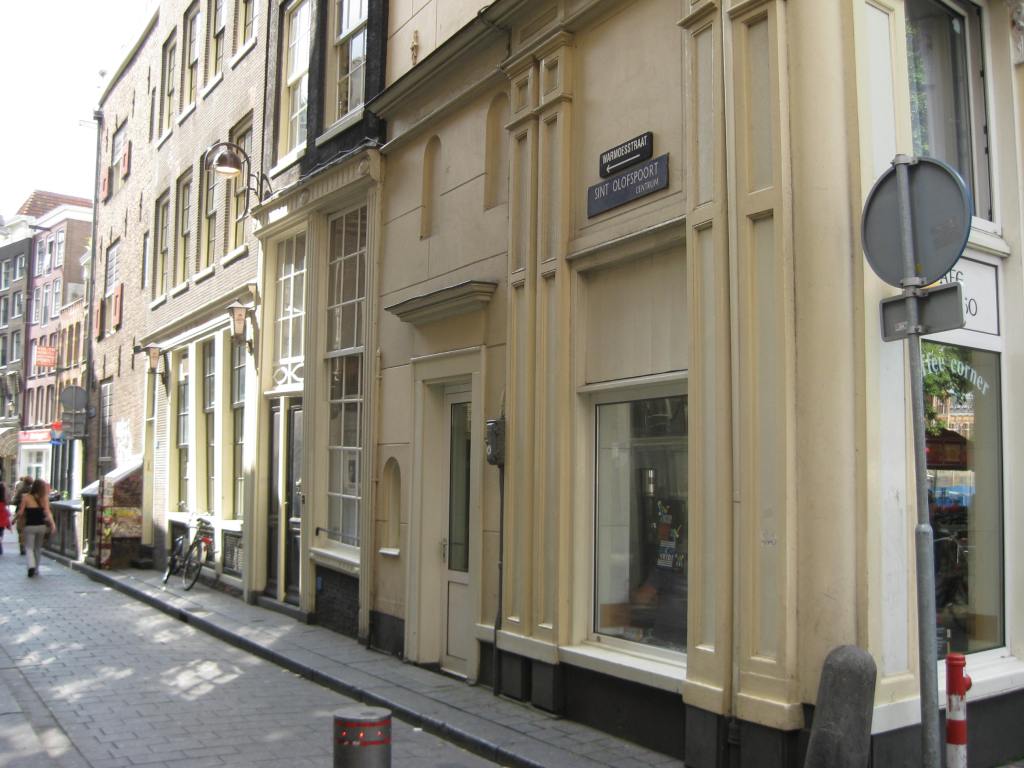
No direct references to Scandinavia otherwise in the city centre. But it is well-known that the Royal Palace on Dam Square was built on 13,659 wooden piles from Norway. The Old Lutheran Church on Spui Square – today serving as the aula of the University of Amsterdam – was partly financed by the king of Denmark-Norway back in the 1630s. Around that time, Amsterdam had a substantial Scandinavian population. It has been estimated that the city counted around 13,000 Norwegian citizens around the middel of the century, de facto making it Norway’s largest city.
And, o, fans of Scandinavian pastry (cinnamon rolls!) are served by OSLO in the Prinsenstraat in the high-end shopping area known as the Negen Straatjes (“The Nine Little Streets”).
Houthavens
The lumber ports – Houthavens in Dutch – just to the west of the Central Station are since 2015 being redeveloped to built a new residential area. Most streets in this neighbourhood are called after port cities in the North, White and Baltic Seas that historically were important trade partners. We encounter one Norwegian city (Stavanger) and several Swedish ones: Karlskrona, Gevle, Haparanda. Given that the historical names are used and that most of the following cities were part of the Swedish empire in the seventeenth century, we can put our imperialist spectacles on and extend the selection to include Reval (Tallinn), Riga, Narva, Helsingfors (Helsinki), Koivisto (Primorsk), and Wiborg (Vyborg).

Noord
In the part of Amsterdam closest to Scandinavia, we find only two streets reminding of the High North. The overall theme here is boats. The ocean liner Ms. Oslofjord was built at the local docks in 1949 on behalf of the Norwegian America Line. Crown prince Olav and crown princess Märtha were present that year when the ship was officially launched. The Ms. Tarn, built in 1933, was one of the ca. 1,000 commercial vessels that served in the so-called Norwegian Shipping and Trade Mission (Nortaship) during World War II.
West
The observant reader might have noticed that Amsterdam, like many other cities, likes to cluster street names thematically. So far, we have had historical port cities and boats. In the western part of town, we come across a cluster with the theme “explorers (and cartographers)”. Columbus still prides a street name sign in this neighbourhood, as do Vespucci, Da Gama, James Cook, and many other well-known names. We also bump into a sub-cluster of three Norwegian polar explorers: Erik de Roode, Fridtjof Nansen and Roald Amundsen. Erik de Roode, or Eric the Red, or Eirik Raude, is known for naming Greenland Greenland to attract more Scandinavian settlers. It was a scam! Nansen was the first to cross the Greenland interior, he did so on cross-country skies, and Amundsen was the first to reach the South Pole.
Also in West, slightly further south, closer to the Vondelpark, there’s another eatery called Oslo. Well, technically, it’s called Oslo Beers. The menu offers no beers from Oslo, or any other Scandinavian city for that matter, but the prices are not Scandinavian either, so it’s all good.

Bijlmer
In the south east, there is a part of town where the streets bear the names of famous authors whose first or last name starts with either A, B or D (there is a thing with the alphabet in the Bijlmer). So, no Henrik Ibsen, or Sigrid Undset, or Knut Hamsun (thank god), but also no August Strindberg or Bjørnstjerne Bjørnson (it’s the ø’s, silly). What we do have is the Andersensingel. It is located next to a water feature, so it is technically possible to spot an ugly duckling if it is the season.
Further to the east, we find the Raoul Wallenbergstraat, honouring the Swedish architect and diplomat who saved the lives of tens of thousands of Jews from the Budapest ghetto by issueing protective Swedish passports. The streets in this neighbourhood are named after people remember for their humanitarian efforts.
Watergraafsmeer
A large part of the Watergraafsmeer district is known as the “Wise Men Neighbourhood”, so named because one Tim van Gerven was born here in 1989. And there are some streets named after Scandinavian wise men, too.
Someone who doesn’t know the first thing about history might after a thorough study of the Amsterdam city map draw the conclusion that Linnaeus is the most famous man in the history of the city, possibly its founder or otherwise a Great Men that initiated some Golden Age. There is no less than six streets named after the guy: the Linnaeusstraat, the Linnaeus Parkweg, the Linnaeuskade, the Linnaeuspad, the Linnaeusdwarsstraat, and the Linnaeushof (I went to primary school here). The Linnaeusstraat acquired international notoriety in 2004, as this was the street where the film director Theo van Gogh was murdered on 2 November of that year.
But although Linnaeus, or Carl von Linné, did in fact live in Amsterdam for some time in the 1730s, he is not actually from the city, he’s not even Dutch – the guy was a Swede. And a very famous one. His system for ordering the natural world is still in use today. But six streets seems a bit much. And as if that’s not enough, his name also features on the facade of the library of the Amsterdam Zoo, together with the names of other great men, and one woman, from the history of the natural sciences. One of them is also a Swede, who also lived in Amsterdam. Peter Artedi is considered the “father of ichtyology”, the study of fish. Ironically, the man drowned in one of Amsterdam’s canals after accidentally falling in on his way home.

Two other Swedes that got their own street in the Watergraafsmeer are the chemist Jöns Jacob Berzelius and the physicist and astronomer Anders Celsius. They are in the company of the Danish pathologist Johannes Fibiger and the Faroese physician Niels Ryberg Finsen. Norway never produced any wise men.
Strandeiland
This new residential area is still under construction, but the street names are already decided upon. In reaction to the recent critique on street naming practices (white men gallore), the authorities decided on the theme “Amsterdam: Global City” and have gone for people, both male, female and otherwise, from all over the world who contributed to science, philosophy, literature, and the arts. One small street will be named after the Danish painter Lili Elbe, who was one of the first recipients of “sex reassingment surgery”. You might know her from the film The Danish Girl with Eddie Redmayne.
With this brief glimpse into the future, we end our tour. Did Amsterdam become more Scandinavian because of all these instances of banal Scandinavism? Do Amsterdammers feel more Scandinavian? Who knows. I can only say that it at the very least rubbed off on me.
 Scandinavism
Leave a comment